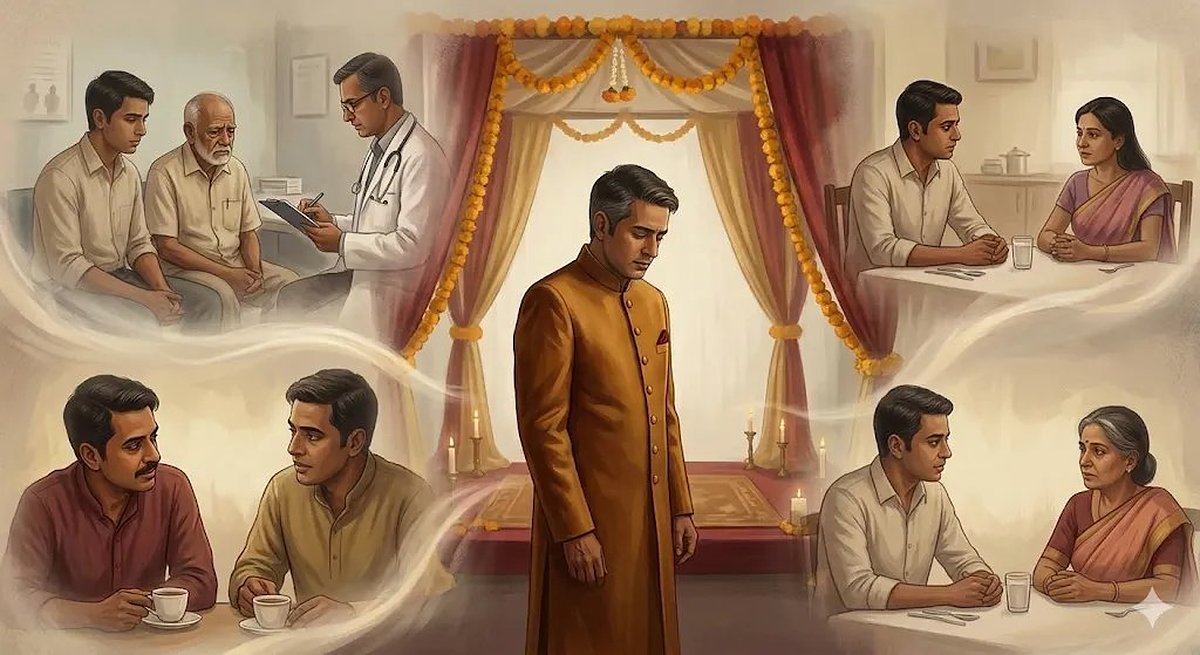
He did not notice it the first few times.
At twenty-four, sitting in a clinic while a doctor read his father’s report, he only noticed the ceiling fan.
At twenty-seven, when someone he loved said, "Can I tell you something honestly?", he noticed his own heartbeat.
At twenty-nine, when his mother asked quietly, "Are you actually happy with the job?", he noticed the dining table had suddenly become too small.
At thirty-one, in an interview, he noticed what happens when a prepared answer runs out and a real person is left standing there.
And much later, at the mandap, he noticed something else.
In the biggest moments of life, people do not always remember the longest speech. They remember the pause after it.
The clinic
The first time he really met silence, he was not alone.
His father was sitting next to him, trying to look normal in the way fathers do. One leg crossed over the other. Face steady. File in hand. As if it was just another Tuesday and not a day everyone had been quietly worrying about.
The doctor opened the report. Then nothing. Just a few seconds.
But in those few seconds, the room changed.
The doctor had not said a word yet. Still, something had already started happening. His mother stopped adjusting the edge of her dupatta. His father stopped pretending to be relaxed. He himself stopped looking at the posters on the wall.
The doctor was only reading. But the silence felt heavy, as if the answer had entered the room before the words had.
He remembers that more clearly than whatever the doctor actually said later. Not because the words were unimportant. Because the silence before them made them real.
That was the first time he understood that some pauses are not empty at all. Some are full of arrival.
"Can I tell you something honestly?"
A few years later, he heard a different kind of silence. It came after a sentence so ordinary that it never looks dangerous at first.
"Can I tell you something honestly?"
It was said over tea, on one of those evenings that begin casually and then take a turn. Street noise outside. Tea getting colder. Two people pretending they are still having a normal conversation.
He said yes. Then came the pause. Not long. Just enough.
Enough for him to realize this was not going to be about work, weather, mutual friends, or weekend plans. Something real was coming.
And in that tiny gap, he could feel the room become more delicate.
That is what he remembered later. Not only what was said. But the silence that came before it, like someone placing a glass object carefully on a table before letting go.
He would think about that moment much later and realise that serious things do not usually arrive with background music. They arrive quietly. And if the other person is decent, they do not rush to fill the space. They let the truth step out at its own speed.
The dining table
At twenty-nine, he was doing well on paper. Good company. Decent title. Steady salary. The kind of life relatives can explain to each other easily.
One night, he was home for a few days, eating dinner with his parents. Nothing unusual. Rotis. Sabzi. Some small complaint about traffic. Some question about whether he was sleeping enough.
Then his mother asked, without any special build-up:
"Are you actually happy with the job?"
That was all. No lecture. No emotional background score. No "we are worried about you." Just the question.
He opened his mouth quickly, the way people do when they want to protect a structure before it collapses.
"Yeah, I mean, it’s good… there’s a lot to learn… team is fine…"
But she did not interrupt. She did not rescue him by asking something easier. She did not start giving advice. She just waited.
And in that waiting, all his professional vocabulary began to sound fake even to him. Growth. Exposure. Brand. Stability.
He had words. What he did not have, at least in that moment, was a true answer.
So the silence stayed there. Not attacking him. Just refusing to leave.
And for the first time, he heard himself say something he had not planned to say.
"I don’t know if I’m unhappy exactly. I just don’t think I can do this for ten years."
That sentence had probably been living inside him for months. Maybe longer. It did not come out because somebody gave him advice. It came out because somebody asked the right question and then did not trample the silence that followed.
The interview
By thirty-one, he had become good at sounding composed. Like most working adults, he had learned the art of managing the room.
You prepare. You smile. You answer clearly. You make weakness look thoughtful. You make uncertainty sound strategic.
The interview was going well until it wasn’t. Then came one question that was not unfair, not tricky, not designed to embarrass him. Just real.
He did not know the answer. At least, not the clean version of it.
He felt it immediately, that tiny collapse inside. The urge to buy time. The wish to say something polished enough that nobody would notice he was suddenly standing without rehearsal.
"So I think there are a few ways to look at that…"
He heard himself beginning the usual escape route. But the interviewer said nothing. No help. No rephrasing. No saving him from the question. Just a pause.
And in that pause, the performance started slipping. Not dramatically. Quietly. He could feel the prepared version of himself becoming less useful by the second.
So he stopped. Then he said the only honest thing available. "I haven’t thought about it clearly enough to answer it well right now."
The room did not collapse. Nobody died. In fact, the rest of the conversation got better.
He left with an uncomfortable little realization: speed had helped him impress people many times. But it had also hidden him. Silence had a way of taking away his cover and leaving behind whatever was actually there. That was not always pleasant. But it was often useful.
The mandap
By the time he reached the mandap, he had already met silence in hospitals, at tea tables, at home, in offices, in questions that did not let him hide. So when it came there too, he recognised it.
Indian weddings are noisy things. Music. Voices. Phones. Instructions. Flowers. Fabric. Priests. Children running exactly where they should not. Everything in motion. Everything speaking.
And then, for a moment, things slow down. The priest pauses. The couple becomes still. Even the room, without being told, understands that this part is different.
Because this is not decoration now. This is not logistics now. This is not "stand here," "look there," "someone fix the dupatta."
This is the moment where words stop being performance and become promise. And promise needs a little quiet around it. Otherwise it sounds like everything else.
Standing there, he understood something he had been learning in pieces for years.
The important thing is not always the sentence. Sometimes it is the pause that lets the sentence become real.
The doctor before speaking. The person before telling the truth. The mother after asking the real question. The interview when the rehearsed answer runs out. The mandap before the final step.
Different rooms. Same secret.
Life changes shape very often in the few seconds when nobody rushes in to rescue the moment.
Maybe that is why some people feel trustworthy without saying much. They do not crowd serious moments. They can sit there while truth catches up. Not coldly. Not dramatically. Just with enough steadiness to let the other person hear what is already rising inside them.
Of course, silence is not always wise. Sometimes it is punishment. Sometimes it is ego. Sometimes it is avoidance. Sometimes it makes a room colder instead of clearer.
He had learned that too.
Silence only helps when it feels safe. When it feels respectful. When it feels like space, not withdrawal.
But the good kind. The kind that does not rush, does not force, does not panic, that kind is rare. And expensive. Not because it sounds impressive. Because it leaves room for what most people cannot tolerate for very long: the truth arriving in its own voice.
By then, he knew enough not to rush that silence. Not in a clinic. Not at a dining table. Not in an interview. Not at the mandap.
Some moments do not need help from more words. They need a little courage from whoever is left in the room when the words are over.
Perhaps that is all silence ever asks of us. Not brilliance. Just the willingness to let the truth arrive before we start speaking again.
Research on the brain’s default mode network suggests that quiet, non-task-focused moments can help with reflection, memory integration, and self-referential thinking. In simple words, silence can give the mind room to process what noise often buries.
Research on silence in therapy and conversation is mixed. In some contexts, silence helps people reflect and say something deeper. In others, it increases anxiety or feels judgmental. The difference often depends on trust, relationship quality, and context.
The meaning of silence is not universal. In some settings it signals respect, thoughtfulness, or seriousness. In others it can feel like disengagement, discomfort, or disapproval. Silence has to be read in context, not treated like a formula.